10 of the Best Email Marketing Campaign Examples You’ve Ever Seen


Most email marketing campaigns follow a familiar formula.
A discount. A product launch. A seasonal promotion. A reminder that something is ending soon.
There is nothing wrong with these campaigns. They work because they are easy to understand and easy to execute.
But every now and then, a brand does something different.
Instead of pushing a product, it builds a challenge around a community. Instead of leading with features, it tells a story. Instead of creating another promotion, it turns an email into an extension of a Super Bowl commercial, an interactive experience, or a cultural moment people are already talking about.
The best email marketing campaigns are not always the biggest or the most expensive. They are the ones that make subscribers pause, pay attention, and remember what they just saw.
In this collection, you’ll find 10 standout email marketing campaign examples that break the mold and show just how creative email can be when brands move beyond the usual playbook.
Email Marketing Campaign Examples
From community challenges and cultural moments to loyalty programs and personality-driven promotions, these examples show the many different ways brands use email to capture attention and drive engagement.
Community Challenge Email Campaign by Insta360
Subject: Ride Like a Champion with Insta360 x UAE Team
This campaign from Insta360 is a great example of how email marketing can support much more than direct sales.
Rather than promoting a product with a discount or limited-time offer, Insta360 built an entire campaign around participation. Subscribers are invited to join a Strava challenge alongside UAE Team Emirates and world champion Tadej Pogačar, with exclusive rewards for those who complete it.
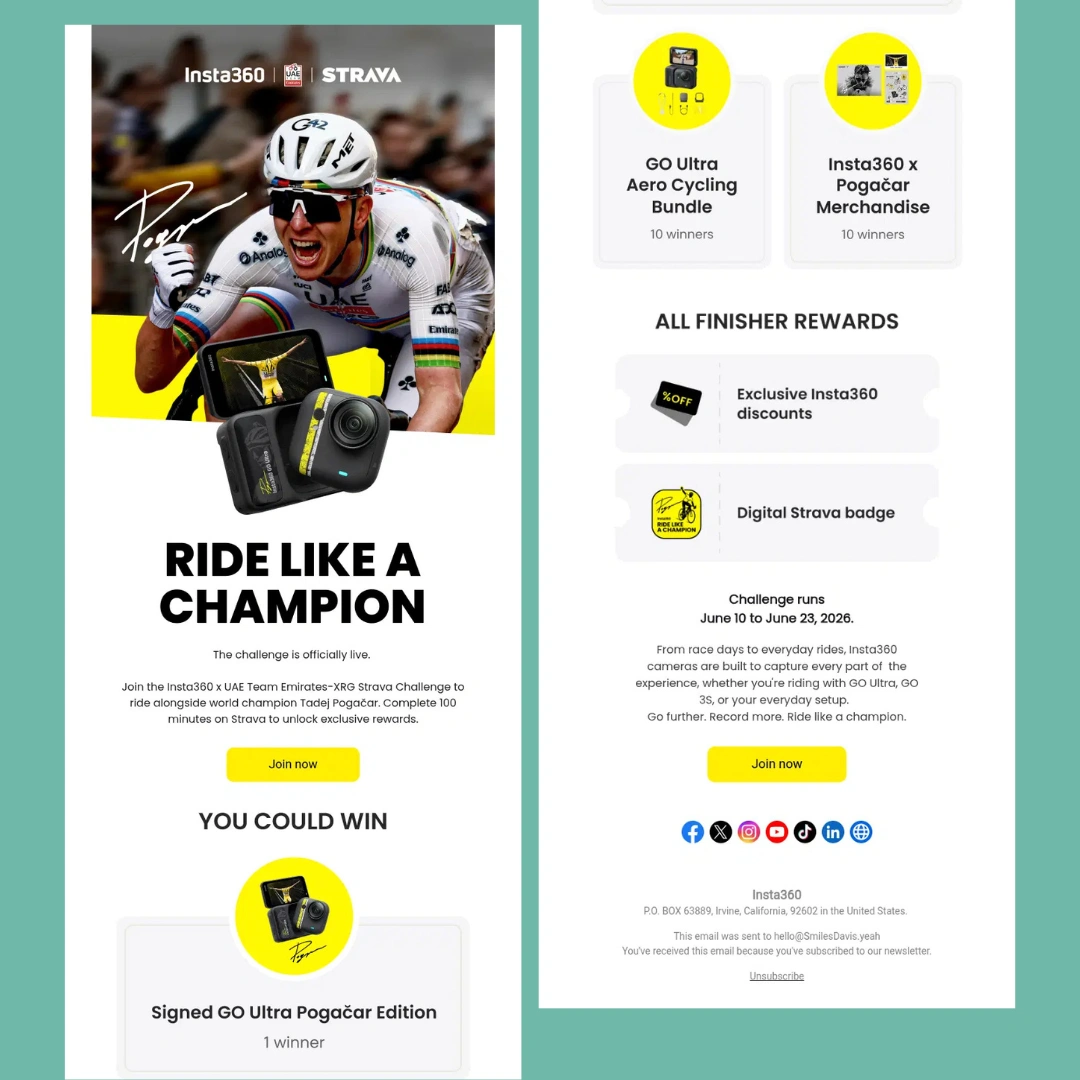
The email immediately creates excitement by combining several powerful marketing elements: a recognizable athlete, a respected sports team, a popular fitness platform, and tangible rewards. Instead of asking readers to buy something, it encourages them to take action and become part of an experience.
What makes this email campaign effective:
- Real-world connection: The campaign connects the product to an activity people can actually participate in instead of simply listing features.
- Credible partnership: The collaboration with UAE Team Emirates and Strava adds instant credibility and visibility.
- Active participation: The challenge encourages subscribers to engage with the brand rather than passively consume content.
- Layered rewards: Multiple reward levels appeal to different types of users and motivations.
- Single objective: The email maintains a clear focus around one primary action, making the next step obvious.
Takeaway: The strongest email campaigns often give subscribers something to do, not just something to buy.
Interactive Flowchart Campaign by Who Gives A Crap
Subject: Don’t fight the flow
This campaign from Who Gives A Crap turns a routine replenishment reminder into something subscribers actually want to engage with.
Instead of leading with a discount, product announcement, or promotional offer, the email presents readers with an interactive flowchart built entirely around the brand’s playful personality. Starting with a simple question, subscribers follow different paths through a series of humorous scenarios before eventually arriving at the same destination: it’s probably time to order more toilet paper.
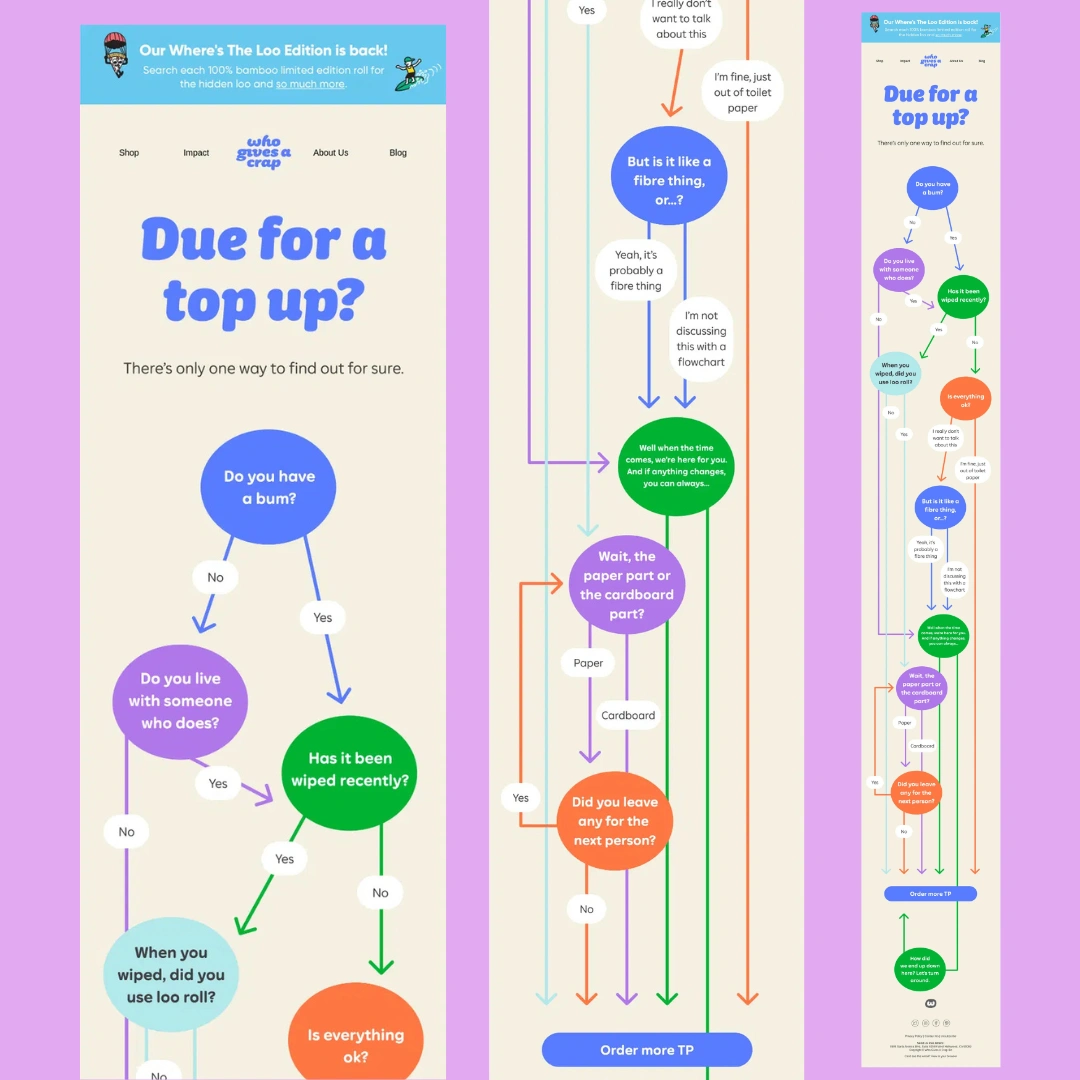
What makes this campaign particularly effective is that the product remains at the center of the experience without feeling like a sales pitch. The journey itself becomes the message. By encouraging readers to actively participate rather than passively scroll, the brand creates a memorable experience around one of the most ordinary household purchases imaginable.
In a crowded inbox full of discounts and product launches, this email succeeds because it feels more like entertainment than advertising.
What makes this email campaign effective:
- Interactive storytelling: The flowchart transforms a simple replenishment reminder into an engaging journey.
- Playful participation: Readers actively follow different paths instead of passively scrolling through a promotion.
- Distinct brand voice: The humor and tone make the email instantly recognizable as Who Gives A Crap.
- Memorable customer experience: The campaign turns an ordinary product category into something surprisingly entertaining.
- Clear conversion path: Despite the playful format, every route naturally leads toward a single action.
Takeaway: Not every email needs a promotion. Sometimes the most effective campaigns turn a simple customer reminder into an experience worth following to the end.
Event-Driven Campaign by Uber Eats x Super Bowl LIX
Subject: $15 off on your first two Uber Eats orders
This Uber Eats campaign is a great example of how email can extend a big brand moment instead of simply promoting around it.
The email builds on Uber Eats’ Super Bowl LIX campaign and brings the same conspiracy-style creative idea into the inbox. The headline “Conspiracy revealed” immediately creates curiosity, while the video thumbnail featuring Matthew McConaughey gives the campaign instant recognition and a clear connection to the broader Super Bowl commercial.
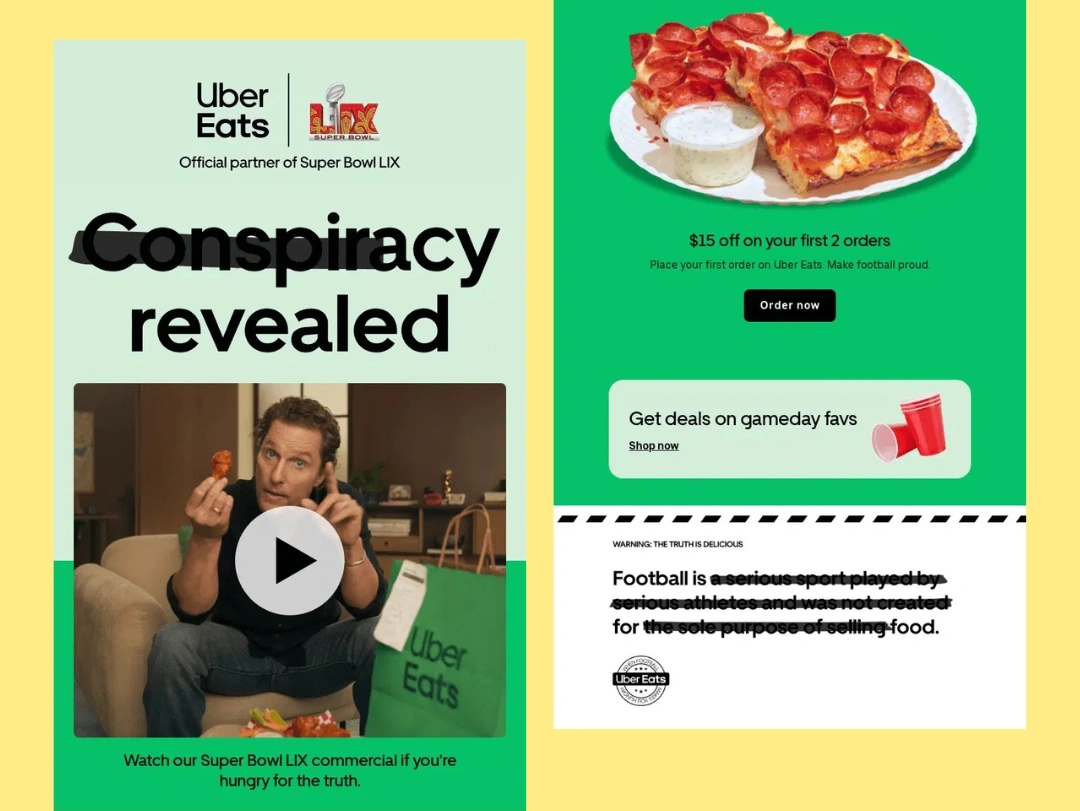
What makes the email especially strong is how committed it is to the concept. The design does not just mention the Super Bowl and move on. It keeps the joke alive through the video placement, the dramatic “truth” language, and even the intentionally crossed-out legal-style statement near the bottom of the email. That small detail makes the campaign feel more complete because the copy, visuals, and fine print all participate in the same idea.
The discount is still there, but it does not feel like the whole campaign. Instead, Uber Eats uses the offer as a natural next step after pulling readers into the story.
What makes this email campaign effective:
- Cross-channel storytelling: The email continues the Super Bowl campaign instead of treating email as a separate promotional channel.
- Celebrity recognition: Matthew McConaughey creates an immediate visual hook and ties the email directly to the commercial.
- Committed creative concept: The conspiracy theme carries through the headline, video, copy, and intentionally crossed-out text.
- Entertainment before promotion: The campaign gives readers something to watch, understand, and enjoy before presenting the offer.
- Offer with context: The discount supports the campaign narrative rather than replacing it.
Takeaway: Email works harder when it becomes part of a larger campaign world, not just a place to repeat the offer.
Minimalist Brand Storytelling Campaign by Squarespace
Subject: Get your domain for $5
This Squarespace campaign shows how powerful email can be when it trusts the audience to fill in the gaps.
The email was sent as part of Squarespace’s Super Bowl campaign featuring Emma Stone. Rather than explaining domain registration benefits or listing product features, the email continues the joke from the commercial. Readers are asked to imagine being Emma Stone and discovering that EmmaStone.com is unavailable, creating an absurd but memorable reminder of why securing a domain name matters.
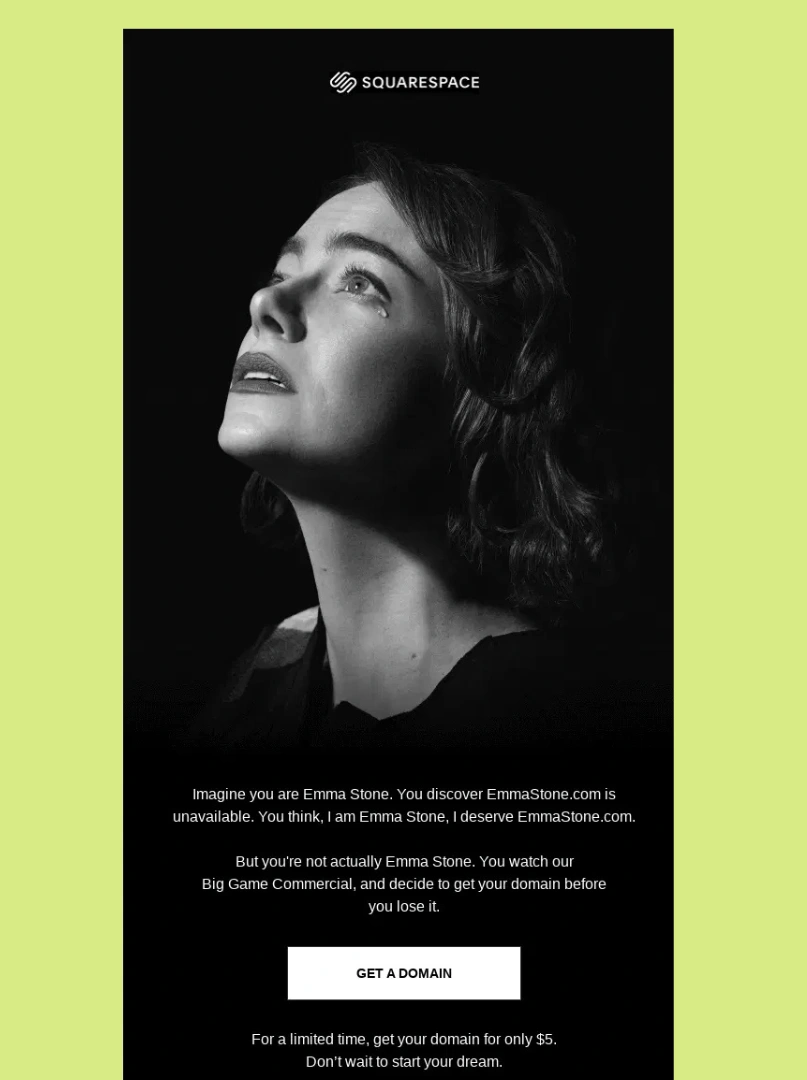
What makes the campaign particularly effective is its restraint. The email relies on a single image, a short piece of copy, and one call to action. Instead of competing for attention with multiple offers or product details, it focuses entirely on reinforcing the campaign idea and driving one simple action.
The result is an email that feels more like a continuation of a story than a traditional promotion. By the time readers reach the CTA, the message has already done its job.
What makes this email campaign effective:
- Campaign continuity: The email extends the Super Bowl commercial rather than repeating a standalone sales message.
- Minimalist execution: A single image, a few lines of copy, and one CTA keep the focus on the core idea.
- Memorable storytelling: The Emma Stone domain-name joke transforms a practical service into a story people are likely to remember.
- Confidence in the audience: The email assumes readers already understand the context, making the message feel smarter and more engaging.
- Single objective: Every element supports one action: securing a domain before someone else does.
Takeaway: When a campaign already has strong awareness, email does not always need to explain. Sometimes the most effective approach is to continue the story and make the next step obvious.
Brand Entertainment Campaign by Tinder
Subject: Delete Tinder because…
Most dating apps spend their marketing budget convincing people to keep using the product. Tinder took the opposite approach.
This campaign answers a surprisingly entertaining question: when is it finally time to delete Tinder?
The email presents a series of increasingly absurd scenarios, from sharing a partner’s Netflix password to surviving a zombie apocalypse, joining witness protection, or accidentally dying. Each situation comes with its own tongue-in-cheek explanation of why it might be safe to leave the app behind.
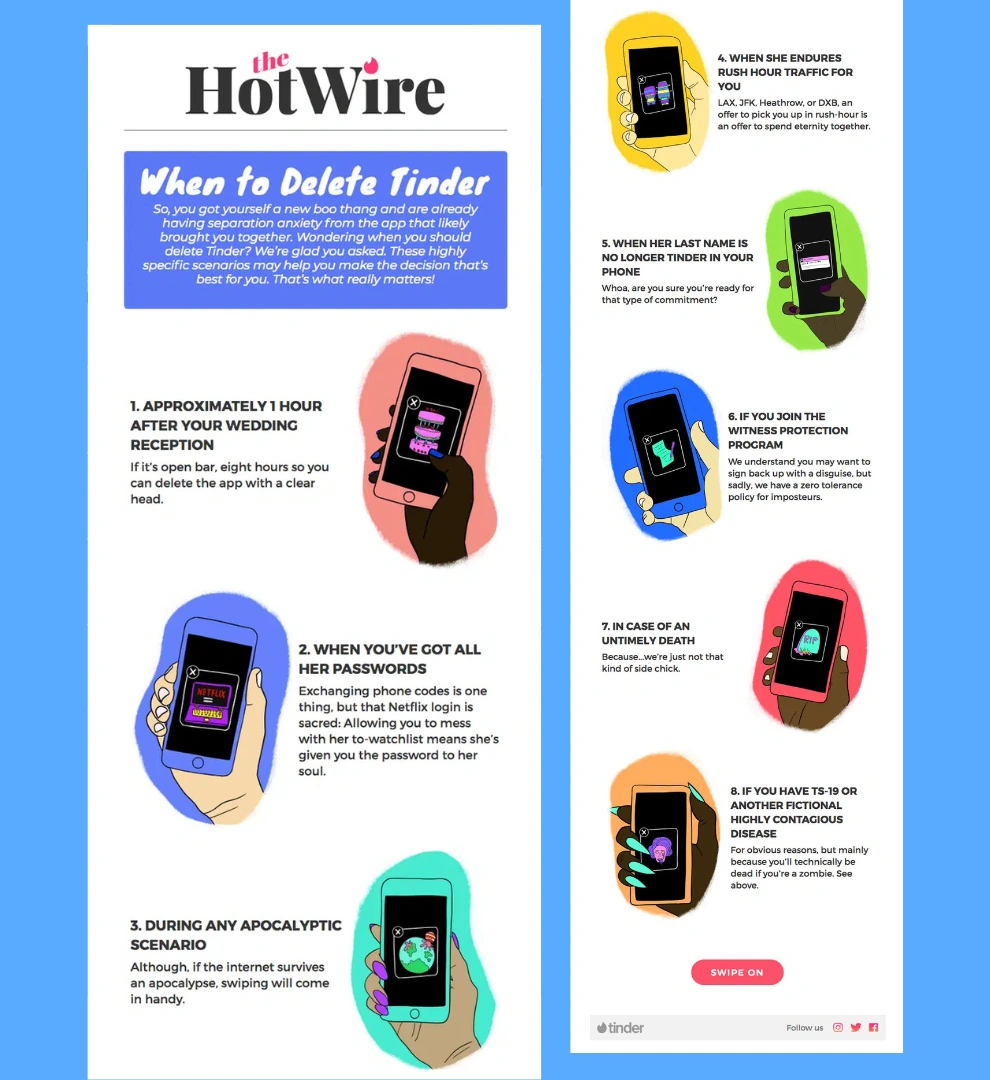
On the surface, it feels like a comedy article. Underneath, it’s a clever brand campaign. Rather than talking about features, subscriptions, or downloads, Tinder reinforces the idea that its ultimate purpose is helping people find meaningful connections.
The result is an email that’s memorable not because it sells something, but because it’s genuinely entertaining to read.
What makes this email campaign effective:
- Unexpected premise: A dating app telling people when to stop using it immediately grabs attention.
- Humor with a purpose: Every joke reinforces Tinder’s core value proposition without feeling promotional.
- Highly shareable concept: The absurd scenarios make the email feel more like content than marketing.
- Strong brand personality: The playful tone is consistent from the first section to the final CTA.
- Product in the background: Tinder remains central to the story without constantly pushing the product.
Takeaway: Some of the most memorable email campaigns don’t sell a product at all. They entertain first and let the brand message follow naturally.
Enjoying these campaign ideas?
We design and code custom email campaigns that look great and work everywhere. At MailBakery, we help brands turn campaign concepts into fully coded email campaigns that render flawlessly across inboxes.
If you’re planning your next campaign, take a look at our email design and coding services.
Character-Driven Holiday Campaign by McDonald’s
Subject: “pucker up, Whoville” – The Grinch
McDonald’s takes a familiar holiday promotion and makes it feel completely different by handing the email over to one of the most recognizable holiday characters in pop culture.
Instead of describing menu items, discounts, or limited-time offers, the campaign is written entirely in the Grinch’s voice. Every line reinforces his sarcastic, mischievous personality, turning what could have been a standard product announcement into a piece of entertainment.
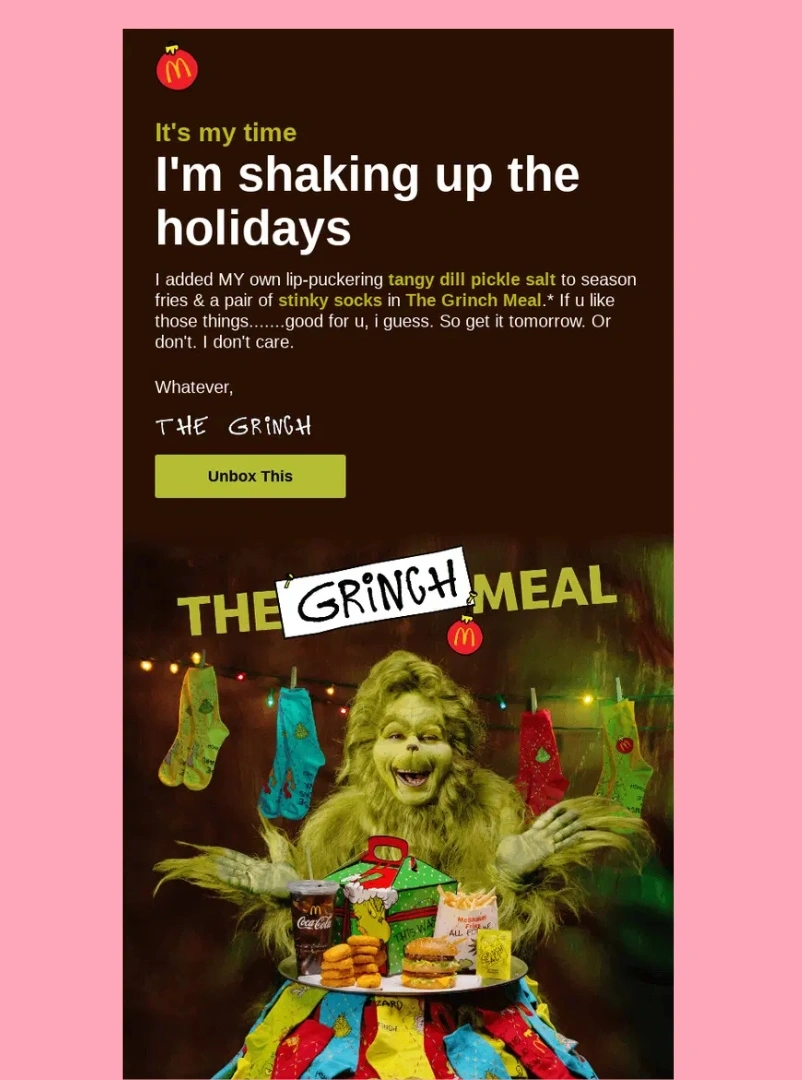
The result feels less like advertising and more like receiving a message directly from the character himself. By the time readers reach the call to action, they are already engaged with the story behind the promotion.
What makes this email campaign effective:
- Character-driven copy: The entire email is written in the Grinch’s voice, creating an experience that feels authentic rather than promotional.
- Entertainment before selling: Readers engage with the humor and personality first, making the product offer feel like a natural extension of the story.
- Memorable brand collaboration: The partnership goes beyond adding a licensed character to the design. The character becomes the campaign.
- Consistent storytelling: Every element, from the headline to the sign-off, reinforces the same mischievous holiday narrative.
- Distinctive brand personality: The campaign stands out because it sounds completely different from traditional fast-food marketing emails.
Takeaway: Collaborations become far more effective when brands adopt the personality behind the partnership instead of simply placing a familiar character on the page. McDonald’s turns a product launch into a character-driven story that readers are likely to remember long after the promotion ends.
Trend-Based Product Launch Email Campaign by Starbucks
Subject: Fresh takes on 2025’s most viral drink
This Starbucks campaign shows how brands can use email to capitalize on existing cultural trends rather than trying to create new ones from scratch.
The campaign centers around the Dubai Chocolate phenomenon, one of the most talked-about food trends of the past year. Instead of simply announcing a new drink, Starbucks positions the launch as part of a larger story that many subscribers already recognize from social media, food blogs, and creator content.
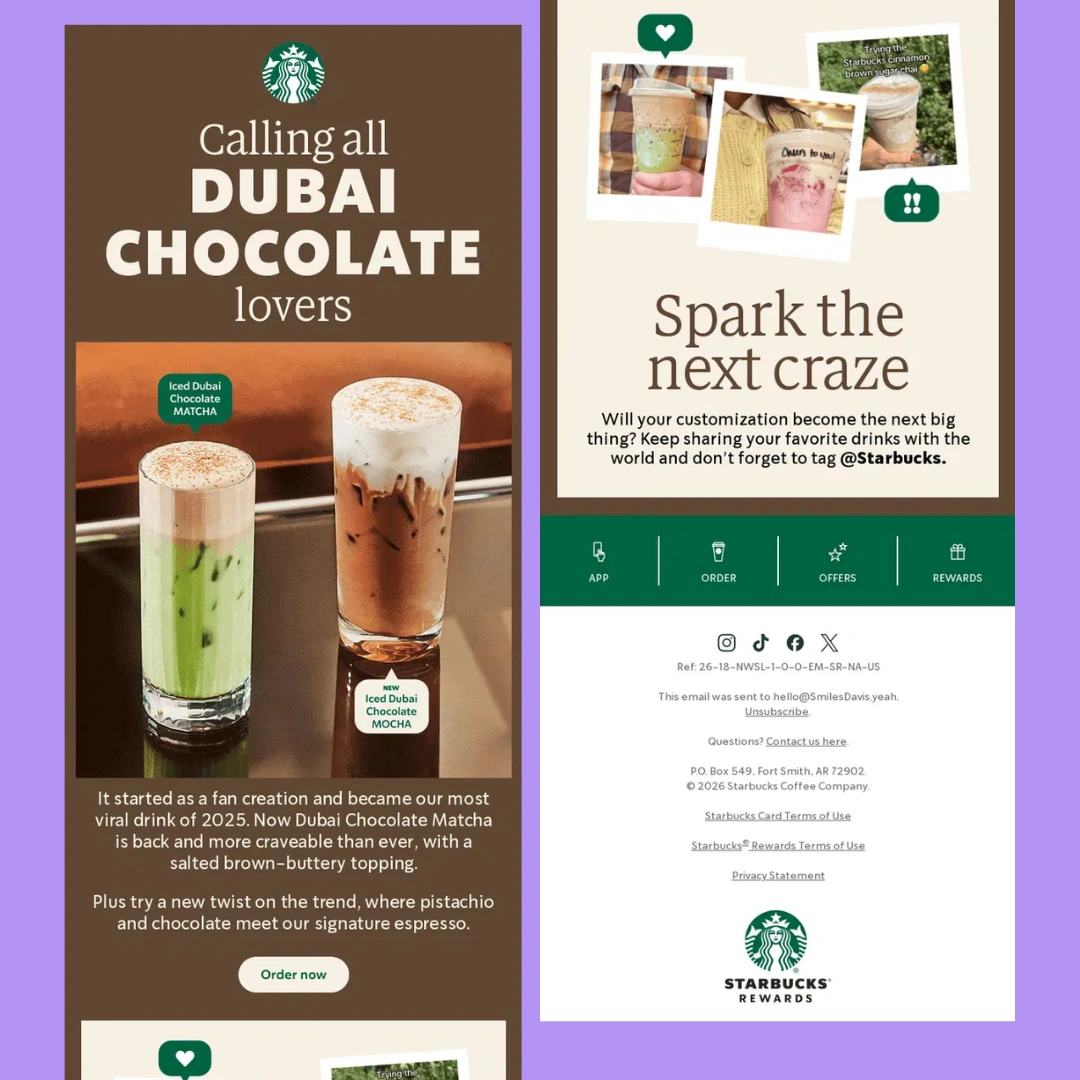
What makes the email particularly effective is that Starbucks acknowledges the community behind the trend. The campaign highlights how a fan-inspired creation evolved into one of the brand’s most viral products and encourages customers to continue sharing their own drink customizations.
Rather than focusing solely on product features, the email taps into curiosity, social proof, and the desire to participate in something people are already talking about.
What makes this email campaign effective:
- Trend-based marketing: The campaign builds on an existing cultural trend instead of trying to create one from scratch.
- Customer-driven storytelling: Starbucks connects the product to customer behavior and social media conversations.
- Social proof: The email reinforces demand by highlighting the drink’s viral popularity.
- Community participation: User-generated content encourages customers to become part of the story.
- Beyond product features: The campaign promotes an experience and a cultural moment, not just a new menu item.
Takeaway: The best email campaigns do not always create trends. Sometimes they succeed by recognizing what customers already care about and finding a way to join the conversation.
Zodiac Product Matching Campaign by Hūha
Subject: Your 2026 Huha Horoscope
This playful campaign transforms a standard product showcase into an interactive horoscope experience.
Rather than organizing products by category, collection, or feature, Hūha assigns a different underwear style to each zodiac sign. The concept has no direct connection to the product itself, which is precisely what makes it memorable.
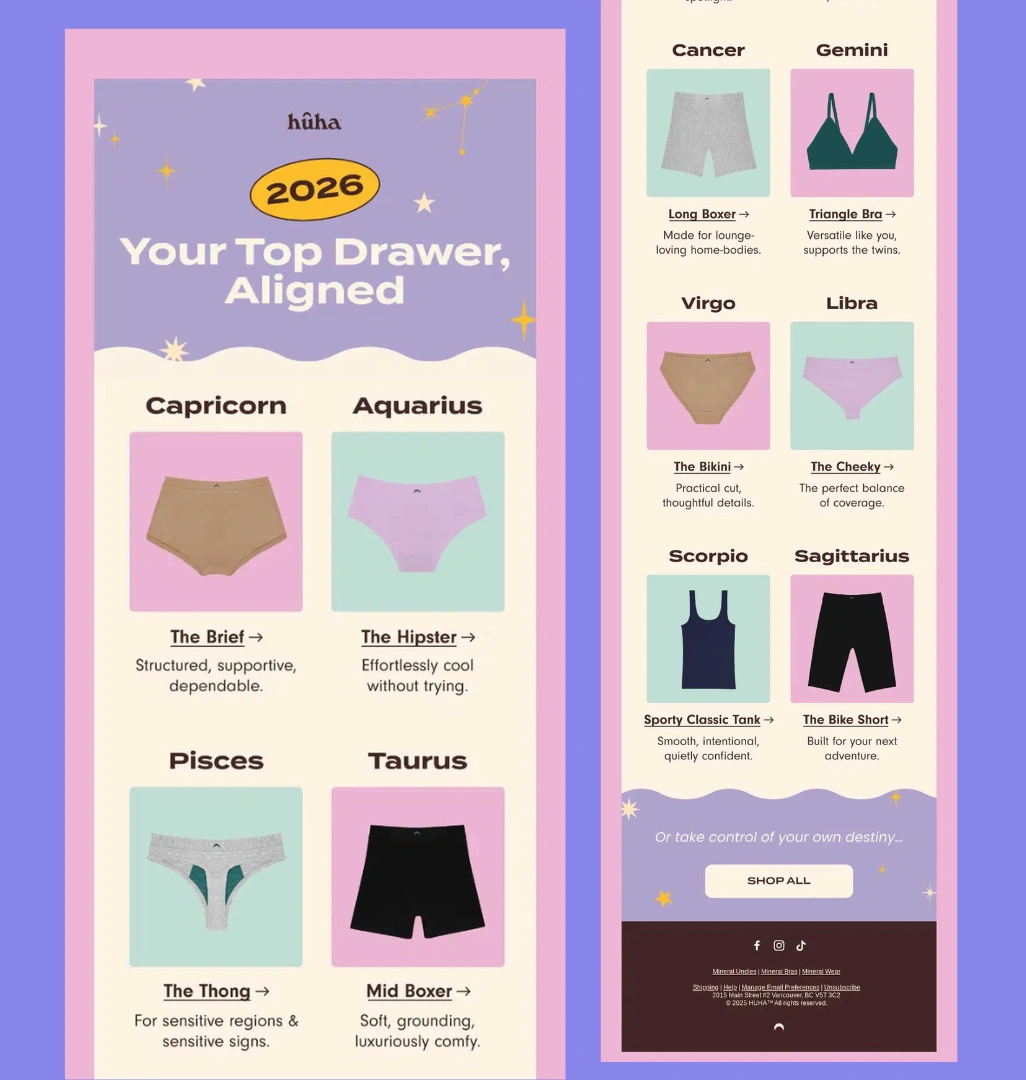
The email taps into the natural curiosity people have about personality quizzes, horoscopes, and identity-based content. Readers are motivated to find their own sign first, then continue exploring the rest of the email to see how other signs compare.
What could have been a simple product grid becomes an engaging experience that encourages scrolling, discovery, and product exploration.
What makes this email campaign effective:
- Identity-based marketing: People naturally engage with content that feels personally relevant, making zodiac signs an effective entry point into the product catalog.
- Built-in curiosity: Most readers immediately look for their own sign, creating a strong incentive to interact with the email.
- Product discovery through entertainment: The horoscope format turns browsing into a playful experience rather than a traditional shopping journey.
- Highly scannable layout: The grid structure makes it easy to compare products while encouraging readers to continue scrolling.
- Shareable concept: The campaign uses a familiar cultural trend that people often discuss with friends, increasing its memorability.
Takeaway: Product catalogs become far more engaging when they are wrapped in a concept people already enjoy interacting with. Hūha uses zodiac signs as a discovery mechanism, transforming a simple assortment of products into an experience readers want to explore.
Subscription Consistency Campaign by Elon Essentials
Subject: The Smarter Way to Restock Your Routine
This campaign from Elon Essentials demonstrates a simple but effective shift in messaging. Rather than focusing on products, ingredients, or discounts, the email focuses on consistency.
The central idea is introduced immediately: real results come from showing up. Instead of positioning subscriptions as a convenient purchasing option, Elon presents them as a tool that helps customers maintain habits and stay on track with their personal care goals.
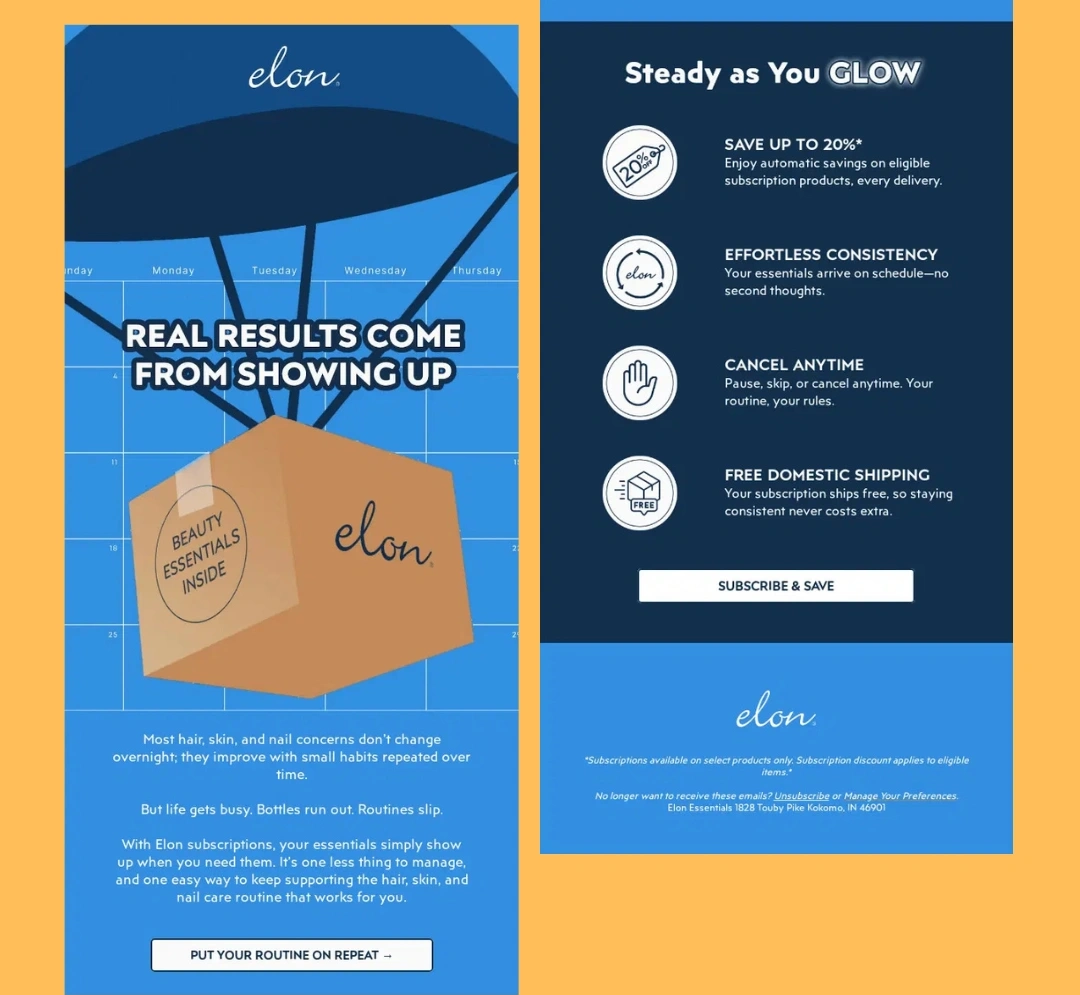
The campaign works because it addresses a common problem many brands overlook. Most customers do not stop using products because they no longer want them. They stop because life gets busy, routines get interrupted, and reordering becomes an extra task.
By connecting subscriptions to the idea of long-term progress, Elon turns a logistical feature into a meaningful benefit. The subscription is not the product being sold. Consistency is.
What makes this email campaign effective:
- Behavior-focused messaging: The campaign sells the outcome of maintaining a routine rather than the products themselves.
- Problem-first positioning: It addresses a real customer challenge before introducing the subscription solution.
- Stronger value perception: Discounts and free shipping support the offer, but they are not the main reason to subscribe.
- Simple visual storytelling: The recurring delivery concept is communicated instantly through the calendar and package illustration.
- Single campaign theme: Every section reinforces the same idea of consistency and long-term results.
Takeaway: Some of the strongest email campaigns do not sell products directly. They sell habits, routines, and behaviors that help customers achieve better results over time.
Subscription Upsell Campaign by Dollar Shave Club
Subject: Confirming your EXECUTIVE razors
Dollar Shave Club shows how a simple subscription reminder can become a smart upsell opportunity when the timing is right.
The email appears just before the customer’s next box ships, when the order is already in motion but there is still time to add more. Instead of asking subscribers to start a new purchase, the campaign makes it easy to add useful extras to something they are already receiving.
That small shift makes the offer feel practical rather than pushy. The customer does not have to browse the whole store, rethink the purchase, or go through a separate shopping journey. They are simply shown a few relevant products that fit naturally into the routine they already have.
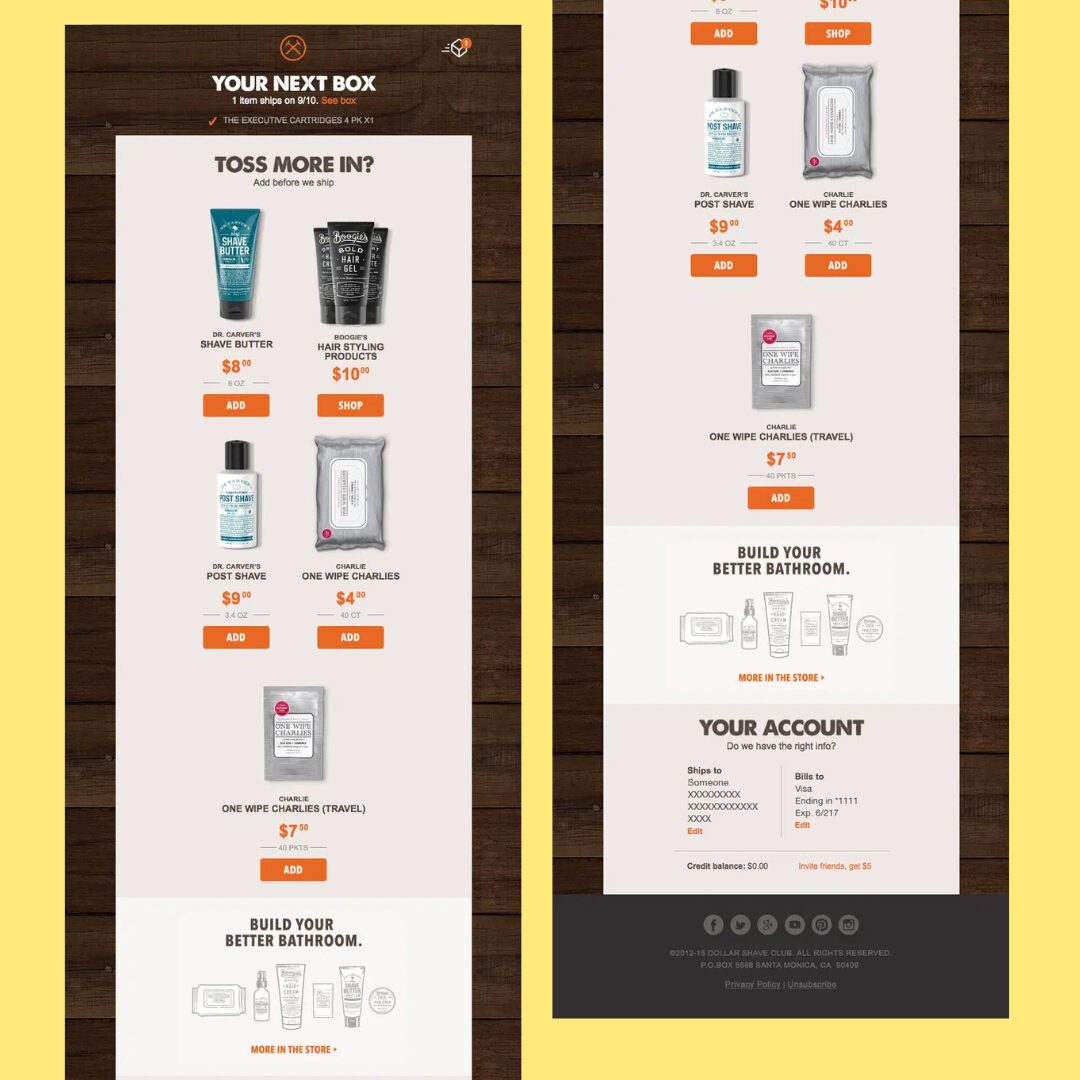
The strength of this campaign is not a big creative concept. It is the way Dollar Shave Club turns a routine account update into a low-friction revenue opportunity. For subscription brands, that kind of timing can be just as powerful as a discount.
What makes this email campaign effective:
- Perfect timing: The offer arrives right before an existing shipment, when purchase intent is already high.
- Minimal friction: Customers can add products without starting a separate shopping journey or checkout process.
- Relevant recommendations: Every suggested item naturally complements the subscription and feels genuinely useful.
- Revenue without discounts: The campaign increases average order value without relying on promotions, coupons, or price reductions.
- Transactional email as marketing: A routine shipment notification becomes a highly effective upsell opportunity.
Takeaway: A good upsell does not always need a new campaign moment. Sometimes it works best when it appears inside a customer moment that is already happening.
FAQ: Best Email Marketing Campaigns
What makes an email marketing campaign successful?
Successful email marketing campaigns start with a clear objective and a strong central idea. The most effective campaigns align the message, design, and call to action around a single goal, whether that is driving sales, increasing engagement, building loyalty, or strengthening brand awareness.
What are the most effective types of email marketing campaigns?
Some of the highest-performing email campaigns include product launches, promotional campaigns, welcome series, loyalty programs, seasonal campaigns, customer retention emails, and personalized recommendations. The best choice depends on the audience and business objective.
How often should businesses send email marketing campaigns?
There is no universal frequency that works for every brand. Many companies send one or two campaigns per week, while others increase frequency during product launches, major promotions, or holiday periods. Consistency is generally more important than volume.
What can businesses learn from successful email marketing campaigns?
The best email marketing campaigns demonstrate that strong concepts often outperform aggressive selling. Many successful campaigns use storytelling, humor, personalization, customer insights, or creative design to earn attention before asking readers to take action.
Do email marketing campaigns need to be heavily promotional?
No. Many of the most memorable email campaigns focus on entertainment, education, brand storytelling, or customer engagement rather than direct promotion. Building a relationship with subscribers often creates stronger long-term results than constant discount-driven messaging.
How can I create better email marketing campaigns?
Start with a clear objective, understand your audience, develop a strong creative concept, and make the desired action obvious. Effective email campaigns also require responsive design, reliable HTML development, thorough testing, and ongoing optimization based on performance data.
Need Help Creating Your Next Email Campaign?
Great campaigns need more than a good idea. They also need strong design, flawless email coding, and reliable rendering across every inbox.
At MailBakery, we help brands turn campaign concepts into high-performing HTML emails that look great and work everywhere.