Klaviyo vs Mailchimp for Shopify. Don’t Choose Until You Read This


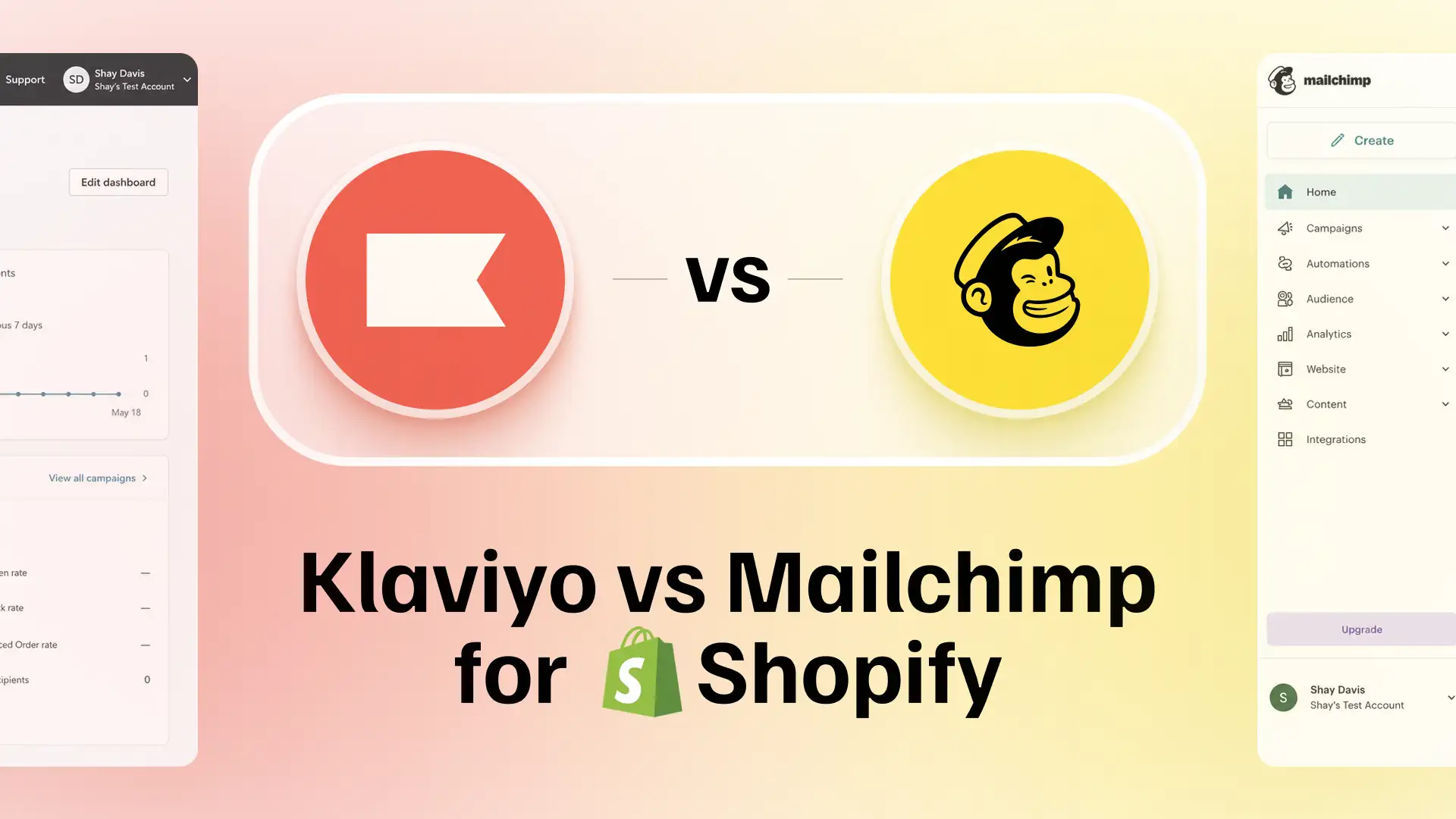
Choosing between Klaviyo and Mailchimp for Shopify is not only about picking an email marketing platform. Both tools can help you send campaigns, build automations, create branded emails, segment customers, and track performance.
The real question is how far you want your Shopify email marketing to go.
Mailchimp can be a good fit for Shopify stores that need familiar campaign tools, newsletters, product promotions, audience management, and simpler automations. It is a broad marketing platform that works well when email is still mostly campaign-led.
Klaviyo is usually the better fit when your Shopify store needs deeper ecommerce automation, behavior-based segmentation, product-driven personalization, and revenue-focused lifecycle marketing. It is built more directly around customer data, purchase behavior, automated flows, and retention.
In this guide, we’ll compare Klaviyo vs Mailchimp for Shopify across the areas that matter most: Shopify data, email campaigns, templates, automations, segmentation, personalization, reporting, pricing, and migration. By the end, you should have a clearer idea of whether Mailchimp is still enough for your store, or whether it makes sense to move to Klaviyo.
Klaviyo vs Mailchimp for Shopify: The Main Difference
Mailchimp and Klaviyo can both work for Shopify stores, but they are built around different marketing needs.
Mailchimp is broader. It supports email campaigns, templates, automations, audience tools, landing pages, forms, ads, SMS, and general marketing workflows. For many small or growing Shopify stores, that can be enough, especially if the main goal is to send newsletters, promotions, product announcements, and occasional automated emails.
Klaviyo is more ecommerce-focused. It is built around customer profiles, Shopify behavior, segmentation, automated flows, product recommendations, and revenue tracking. That makes it especially useful for stores that want email marketing to support the full customer journey, from first signup to first purchase, repeat purchase, retention, and reactivation.
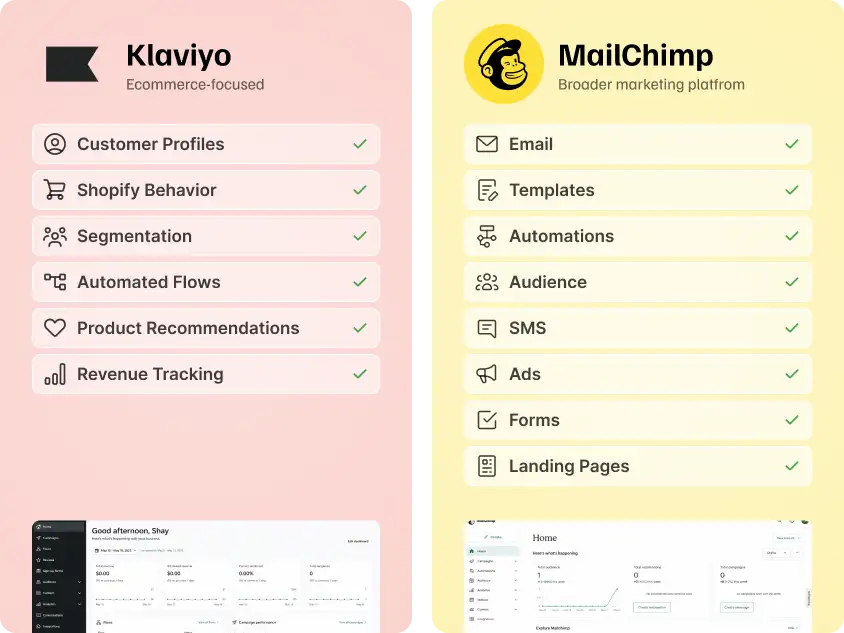
So the decision is not simply “Which platform can send emails?” Both can. The better question is whether your Shopify store needs a general campaign platform or a more ecommerce-specific lifecycle marketing system.
Mailchimp is not a weak option for Shopify. It can work well for stores that need a familiar email marketing platform for regular campaigns, newsletters, promotions, and simple ecommerce automations.
Klaviyo becomes more compelling when email marketing needs to respond to customer behavior. If you want to build flows around browsing, cart activity, purchases, product interest, repeat buying, and customer lifecycle stage, Klaviyo usually gives Shopify stores more room to grow.
How They Compare Across Shopify Email Marketing Needs
A useful Klaviyo vs Mailchimp comparison should go beyond feature lists. For Shopify stores, the real question is how each platform supports ecommerce data, campaign creation, automation, segmentation, reporting, and growth over time.
Both platforms can support Shopify email marketing. The difference becomes clearer when email moves from simple campaigns to customer journeys, repeat purchases, and revenue-focused automation.
Shopify Data and Customer Profiles
Both Mailchimp and Klaviyo can connect with Shopify and use ecommerce data. The difference is how central that data becomes to your email marketing strategy.
Campaign Creation and Email Templates
Both platforms give Shopify stores tools to create branded email campaigns. The difference is whether your templates mainly support regular campaigns, or whether they also need to work across automated ecommerce flows.
Automation and Shopify Flows
Mailchimp and Klaviyo both support automation, but this is where the comparison starts to lean more clearly toward Klaviyo for Shopify stores. Mailchimp can handle common journeys and abandoned cart workflows, while Klaviyo is built more heavily around behavior-based ecommerce flows.
Segmentation and Personalization
Both Mailchimp and Klaviyo support segmentation and personalized messaging. The difference is how deeply ecommerce behavior can shape the campaigns and automations each customer receives.
Reporting and Revenue Tracking
Both platforms give Shopify stores reporting tools for campaigns, audience activity, and revenue. The difference is that Mailchimp is stronger for general marketing and campaign reporting, while Klaviyo puts more emphasis on ecommerce performance, attribution, flows, and repeat purchase behavior.
Pricing and Scalability
Pricing for both platforms depends on list size, send volume, plan level, and channel usage. Mailchimp’s pricing is built around plan type, contact count, and monthly email send limits, while Klaviyo’s paid plans scale mainly by active profiles and channel usage such as email and SMS.
So, Which Platform Fits Which Shopify Need?
Mailchimp and Klaviyo can both work for Shopify stores, but they are not usually the best fit for the same type of email marketing program.
Mailchimp makes more sense when your Shopify email marketing is still mostly campaign-led. It works well for stores that need newsletters, product announcements, promotions, seasonal campaigns, simple customer journeys, and broader audience targeting.
Klaviyo makes more sense when your email marketing needs to become more behavior-led. It is usually the stronger option when Shopify data needs to shape automated flows, customer segments, product recommendations, retention campaigns, and revenue-focused lifecycle marketing.
Klaviyo is a better fit when:
- You want Shopify behavior to shape automated flows and customer journeys.
- You need flows such as welcome series, abandoned cart, browse abandonment, post-purchase, win-back, and back-in-stock emails.
- You want more granular ecommerce segmentation based on browsing behavior, purchase history, engagement, and customer properties.
- You care about revenue attribution, repeat purchase behavior, and flow performance.
- You want email marketing to support retention and customer lifetime value, not just campaign sends.
Mailchimp is a better fit when:
- Your email marketing is mostly focused on newsletters, promotions, and product updates.
- You need a familiar campaign builder and a broader marketing platform.
- Your automations are simple and do not require complex ecommerce logic.
- Your segmentation needs are useful, but not deeply tied to lifecycle stages or advanced Shopify behavior.
- You want a practical starting point for regular Shopify email campaigns.
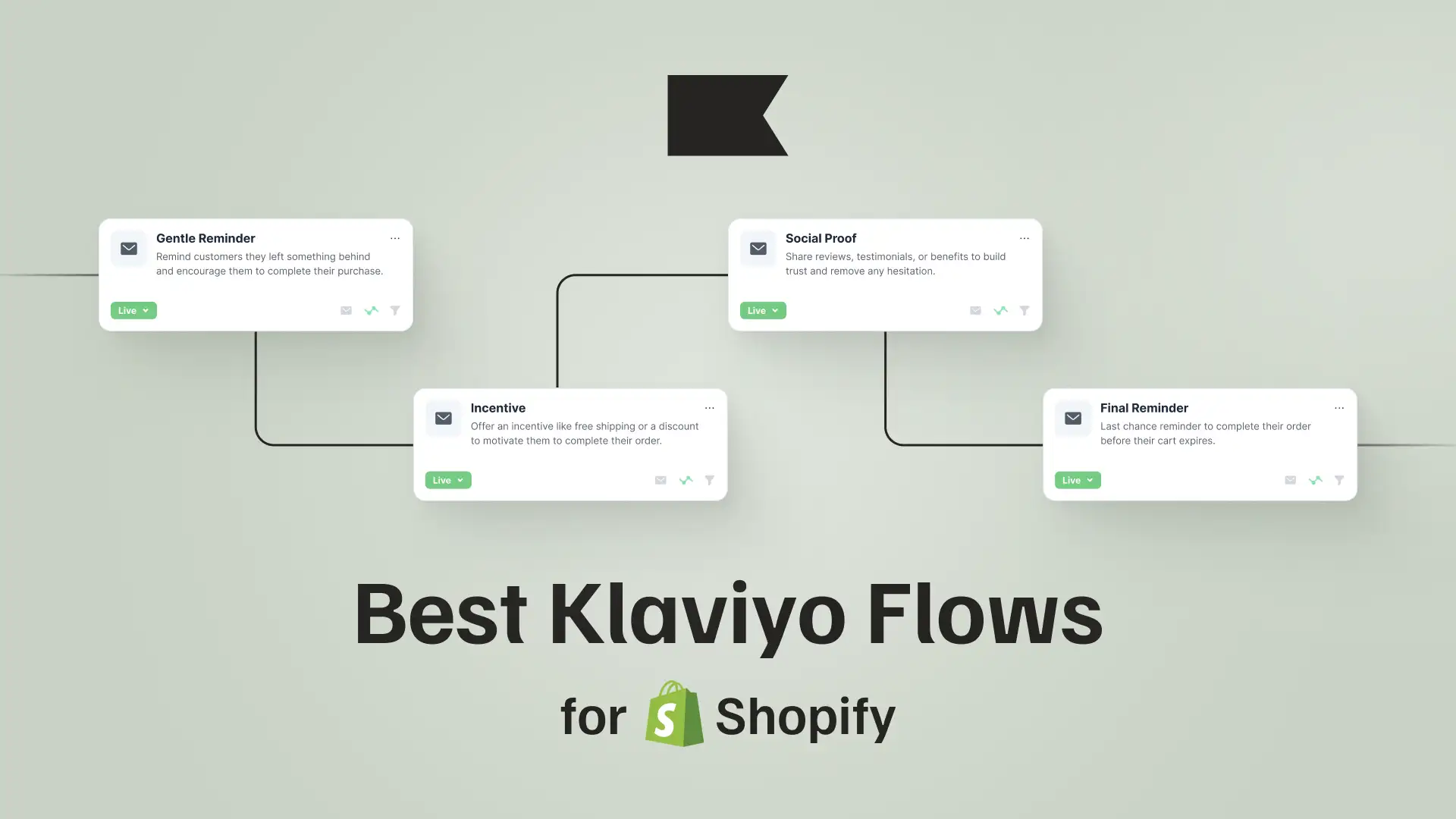
If you are leaning toward Klaviyo because of its automation features, start by reviewing the best Klaviyo flows every Shopify store should consider.
Should You Move from Mailchimp to Klaviyo?
Switching from Mailchimp to Klaviyo can make sense when your Shopify store has outgrown a campaign-first email setup. The move is usually less about changing email builders and more about rebuilding how your store uses customer data, segments, automations, and revenue reporting.
You may be ready to move from Mailchimp to Klaviyo if:
- Your abandoned cart, post-purchase, and win-back emails need more control.
- You want to segment customers by Shopify behavior, purchase history, product interest, and lifecycle stage.
- Your current setup relies heavily on campaigns, but not enough on automated revenue flows.
- You want clearer reporting around flows, customer journeys, and ecommerce revenue.
- You need email templates that work consistently across campaigns and automations.
- Your store has enough traffic, orders, and customer data to benefit from a more advanced ecommerce email platform.
A Mailchimp to Klaviyo migration is not just a contact import. A clean migration usually includes list cleanup, audience structure, segments, signup forms, branded templates, core Shopify flows, tracking, reporting, and QA before launch.
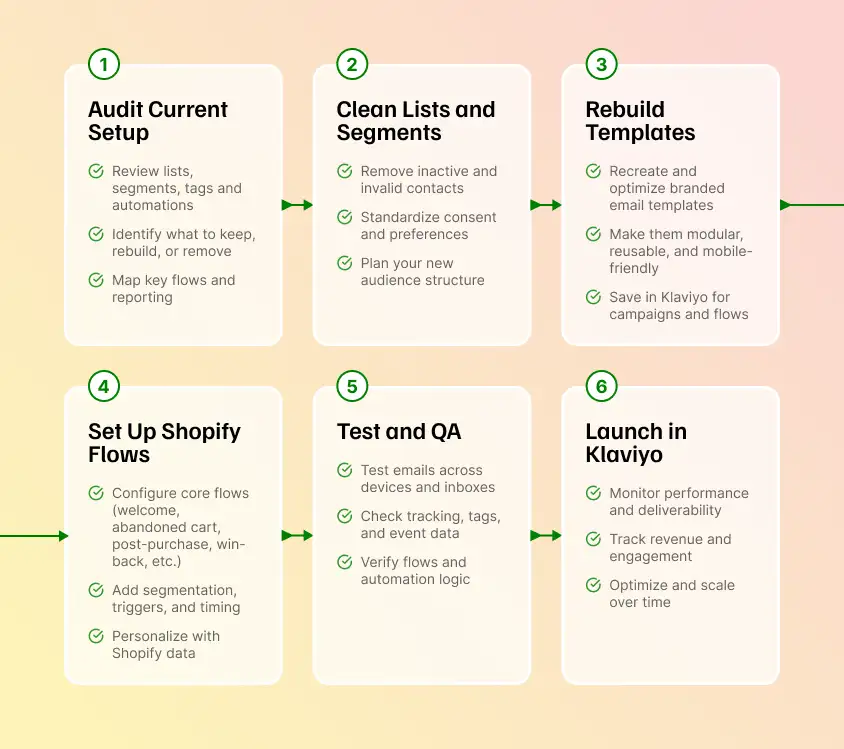
This is also a good point to review what should stay, what should be rebuilt, and what should be removed. Some Mailchimp campaigns or audiences may still be useful as references, but Klaviyo works best when the setup is rebuilt around Shopify behavior rather than copied over exactly.
FAQ: Klaviyo vs Mailchimp for Shopify
Is Klaviyo better than Mailchimp for Shopify?
Klaviyo is usually better for Shopify stores that need advanced ecommerce automations, behavior-based segmentation, product recommendations, and revenue reporting. Mailchimp can still be a good choice for stores that mainly need newsletters, promotions, product updates, and simpler customer journeys.
Is Mailchimp good for Shopify stores?
Yes. Mailchimp can work well for Shopify stores that want a familiar email marketing platform for campaigns, audience management, templates, basic automations, and product promotions. It becomes less ideal when the store needs more advanced Shopify flows, deeper customer behavior targeting, and lifecycle revenue tracking.
Does Klaviyo integrate better with Shopify than Mailchimp?
Klaviyo is more ecommerce-focused and is built heavily around Shopify customer data, order history, product behavior, segments, and flows. Mailchimp also connects with Shopify and syncs ecommerce data, but Klaviyo is usually stronger when that data needs to drive advanced automations and customer journeys.
When should I switch from Mailchimp to Klaviyo?
You should consider switching from Mailchimp to Klaviyo when your Shopify store needs more control over abandoned cart emails, post-purchase flows, win-back campaigns, customer segments, product recommendations, and revenue reporting. The switch makes the most sense when your store has enough traffic, orders, and customer data to benefit from a more advanced ecommerce email setup.
Can I use Mailchimp and Klaviyo together?
Technically, yes, but most Shopify stores should avoid running overlapping email campaigns and automations from both platforms. If both tools are used at the same time, their roles should be clearly separated to avoid duplicate messages, inconsistent customer data, and confusing reporting.
Is Klaviyo worth it for small Shopify stores?
Klaviyo can be worth it for small Shopify stores if email automation, customer data, and repeat purchases are already important to growth. If the store only sends occasional newsletters or simple promotions, Mailchimp may be enough until the email strategy becomes more advanced.
What should I migrate from Mailchimp to Klaviyo?
A Mailchimp to Klaviyo migration usually includes contacts, lists, segments, signup forms, email templates, automations, suppression data, and reporting references. It is also a good time to clean up old audiences, rebuild core Shopify flows, and create a more ecommerce-focused email structure.